
Living in Chestnut
Hill
Chestnut Hill is Philadelphia's stone village, an affluent, architecturally significant neighborhood in the far northwest corner of the city where a historic main street of boutiques, galleries, and restaurants lines Germantown Avenue and grand Victorian homes sit on tree-lined blocks. With the Wissahickon Valley Park at its edge and two SEPTA Regional Rail lines into Center City, it offers small-town character, top schools, and some of the city's most coveted real estate.
Chestnut Hill's stone village,
set apart from the city
Chestnut Hill began as a crossroads village in the early 1700s, its name appearing in deeds by 1711, and it was shaped into a planned railroad suburb in the 1880s and 1890s when developer Henry Howard Houston extended the Pennsylvania Railroad and built scores of homes around it. Today the neighborhood is one of the city's most distinctive places: a National Register Historic District covering essentially the whole section, anchored by a village center that feels more like a New England town than a Philadelphia street.
Day to day, life revolves around Germantown Avenue, where boutique shops, restaurants, cafes, and galleries fill historic storefronts, and the surrounding blocks are lined with gray Wissahickon schist Victorian homes, many on historic registers. The Wissahickon Valley Park and the wider Fairmount Park system wrap around the neighborhood, giving residents a forest preserve on the doorstep, while two SEPTA Regional Rail lines carry commuters into Center City in roughly half an hour.
That combination, beauty, history, walkability, schools, and parkland, makes Chestnut Hill one of the most sought-after markets in Philadelphia. It also means the housing here is in permanent demand, which matters whether you are buying your way into the village or thinking about selling and moving on.
Two SEPTA rail lines
into Center City
Chestnut Hill is one of the few Philadelphia neighborhoods served by two Regional Rail lines. The Chestnut Hill West line runs from Chestnut Hill West station through Highland, St. Martins, and Allen Lane and reaches Center City in roughly 36 minutes, while the Chestnut Hill East line runs from Chestnut Hill East station and makes the trip in about 30 to 40 minutes depending on the run and the time of day. With two lines to choose from, commuters can pick whichever schedule fits their day.
SEPTA buses round out the picture, with routes running along Germantown Avenue and connecting to the wider Northwest, and driving downtown takes roughly 30 to 45 minutes depending on traffic. Whether you ride the rail in for work or catch a bus along the avenue, Center City is a short, reliable trip from Chestnut Hill, which is a big part of why the village works so well for city professionals and families alike.
Germantown Avenue village life and
the Wissahickon on your doorstep
Chestnut Hill's commercial heart is the historic village center along Germantown Avenue, a stretch of boutique shops, restaurants, bakeries, and galleries organized by the Chestnut Hill Business District, with a farmers' market and year-round events adding to the daily rhythm. The dining scene has been filling back in with fresh arrivals, including The Blue Warbler, an all-day bakery, cafe, and restaurant that opened in mid-2026 at 8001 Germantown Avenue, and Lovat Square, a wine shop that debuted at 184 East Evergreen Avenue in February 2026 with plans to expand into a wine bar and garden restaurant. Around it, green space expands the pace: the Wissahickon Valley Park, Forbidden Drive, and the creek lie right at the neighborhood's edge, and in late 2025 Wissahickon Trails completed a nine-mile trail system linking five nature preserves, with the Woodmere Art Museum's new Frances M. Maguire Hall also opening that fall. It is a mix of small-town energy and deep green calm that is hard to find in a single ZIP code.
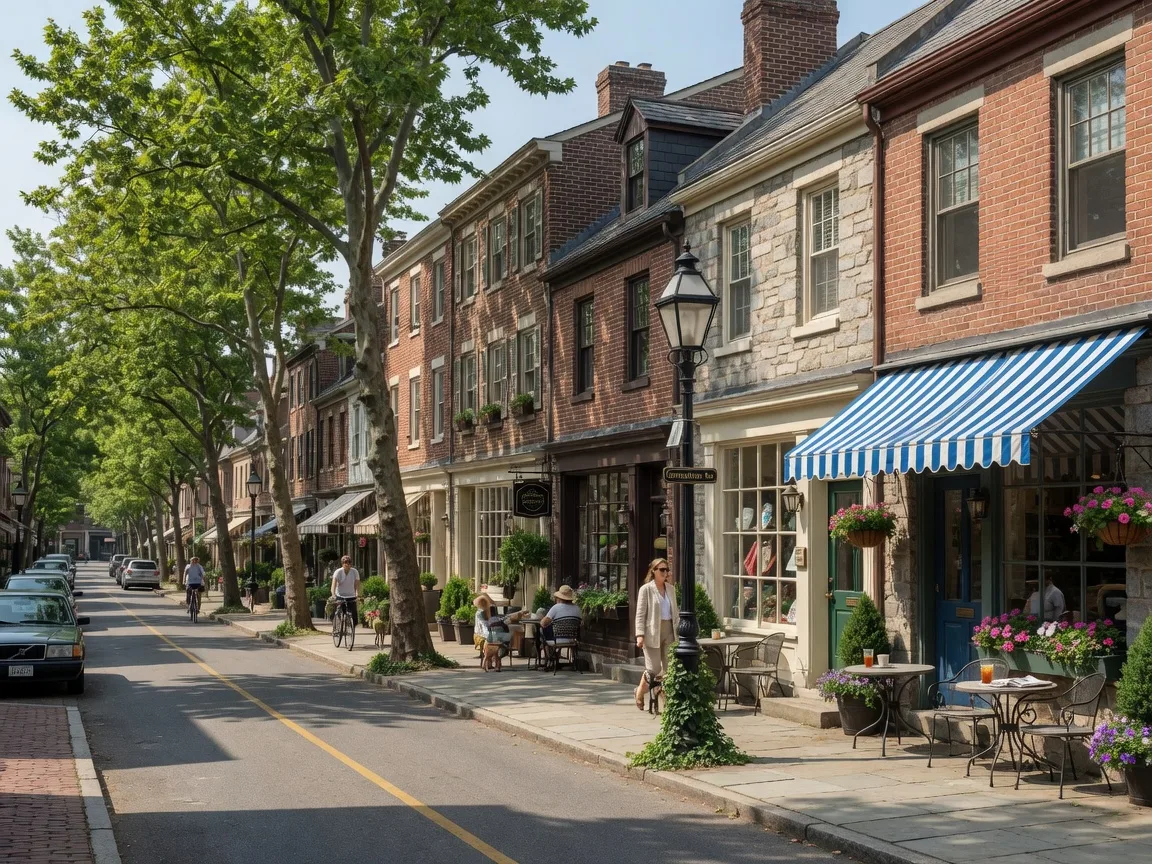
Chestnut Hill's historic main street, lined with boutique shops, galleries, cafes, and restaurants where neighbors gather daily.
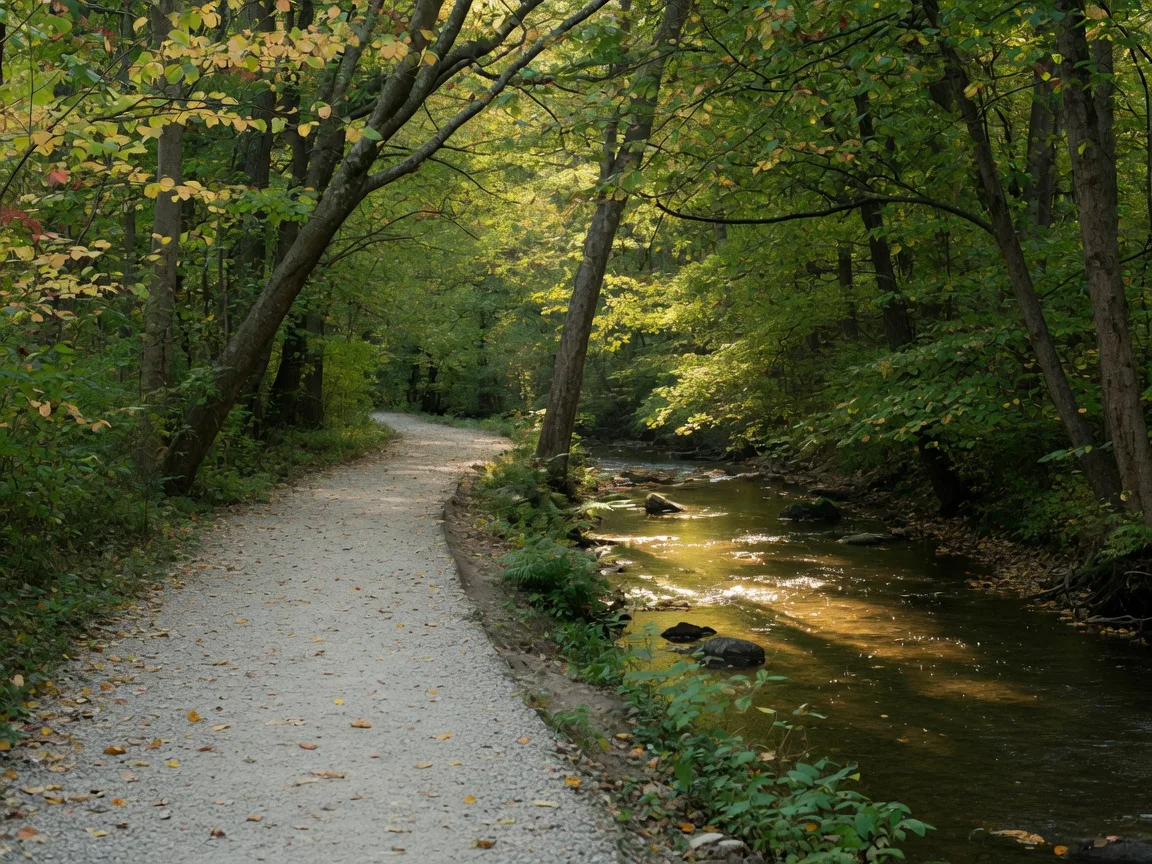
Miles of trails, Forbidden Drive, and the creek define the neighborhood's green edge, a forest preserve of 1,800 acres.
Historic stone homes on one
of Philadelphia's grandest streetscapes
Walk almost any side street in Chestnut Hill and you will see the neighborhood's signature housing: large gray Wissahickon schist Victorian homes from the late 1800s and early 1900s, along with Colonial Revival, Tudor, and other early-20th-century styles, many on historic registers and many standing on landscaped lots with porches and deep windows. Because essentially the whole section is a National Register Historic District, the character of the streetscape is protected and preserved. Scattered among the grand homes you also find smaller stone twins, carriage houses, and more modest houses, giving buyers more range than the neighborhood's reputation suggests.
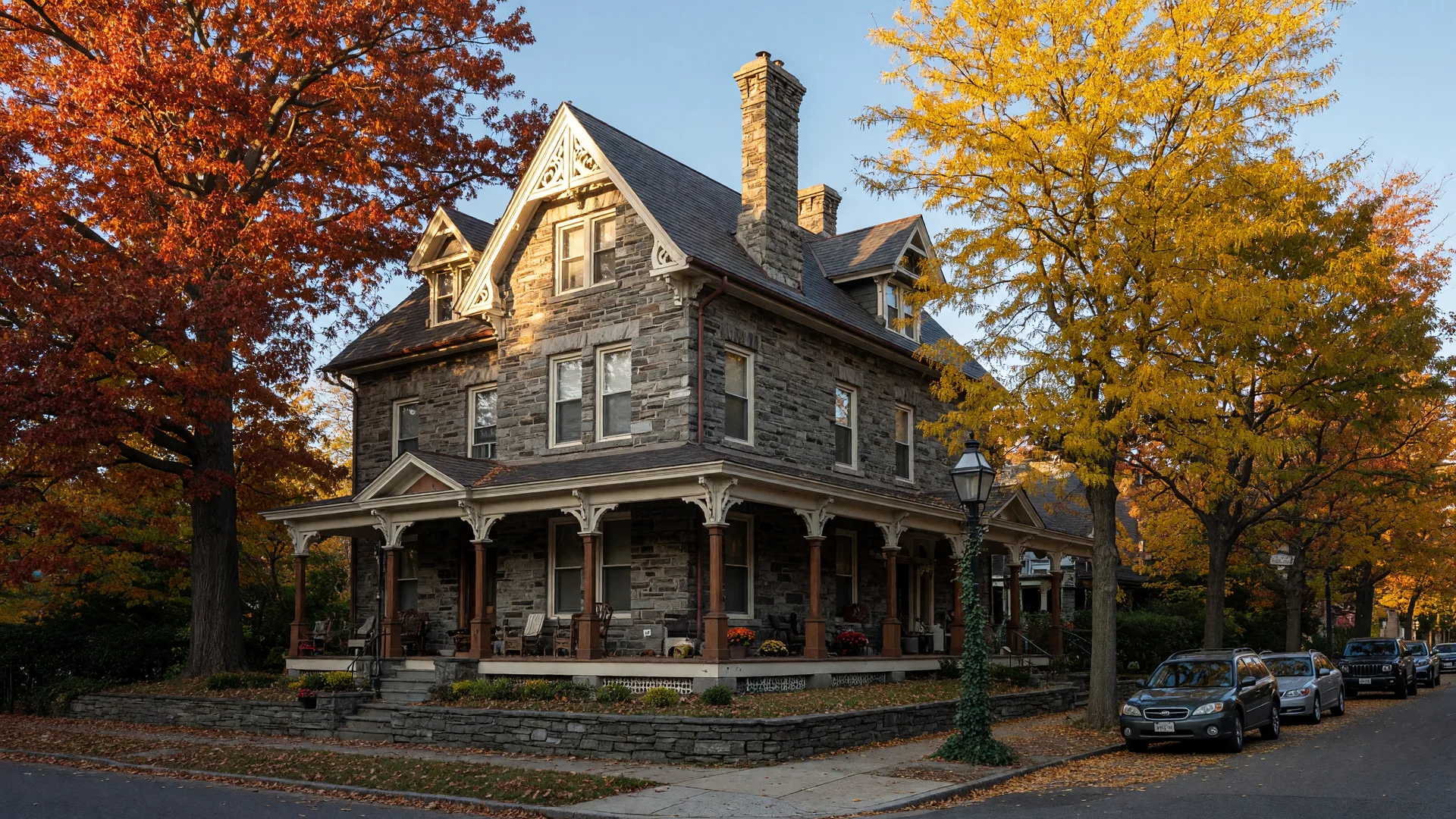
Prices reflect the rarity of the stock. Recent reporting puts the median sale price in the 19118 ZIP code around $975,000, with average sale prices near $1 million and median home values typically reported between roughly $714,000 and $941,000 depending on the source and the mix of homes sold. Large stone homes on the best streets command well over a million, while smaller twins and updated homes on side streets offer more accessible entry points. Inventory is limited and demand is constant, so serious buyers benefit from acting when the right home comes up.
Top schools and a
tight-knit village community
Schools
The neighborhood's public elementary and middle grades are served by Jenks Academy for the Arts and Sciences, an International Baccalaureate school on Germantown Avenue, with high school students routed to district options such as Martin Luther King High School, The Academies at Roxborough, and Lankenau Environmental Science Magnet High School depending on the address. Chestnut Hill is also home to notable private schools, including Springside Chestnut Hill Academy, the city's largest independent preschool-through-grade-12 school, plus Norwood-Fontbonne Academy, Our Mother of Consolation, and The Crefeld School. The School District of Philadelphia School Finder is the authoritative way to confirm a specific home's assignment.
Community Feel
Chestnut Hill is famously civic-minded, anchored by the Chestnut Hill Community Association, founded in 1957 as Philadelphia's first registered neighborhood association, and the Chestnut Hill Business District, which keeps the village center thriving with festivals, a farmers' market, and gallery walks. Blocks mix longtime families, professionals, artists, and academics in a friendly, old-fashioned setting where neighbors know one another and buy and stay for decades, which keeps demand and resale values strong.
Common questions about
living in Chestnut Hill & 19118
The questions homebuyers and sellers most often ask about the Chestnut Hill section of the 19118 area, answered in full.
01 Is Chestnut Hill a good place to live?
Yes, and it consistently ranks among Philadelphia's most desirable places to live. Chestnut Hill is a leafy, affluent village in the far northwest corner of the city, built around a historic commercial center on Germantown Avenue and surrounded by the green of the Wissahickon Valley and Fairmount Park. It combines a small-town main street, some of the city's most architecturally significant homes, strong public and private schools, and two SEPTA Regional Rail lines that put Center City about half an hour away. Residents describe a tight-knit, civic-minded community with festivals, a farmers' market, galleries, and a pace that feels a world apart from downtown while still being inside the city limits. It is not the cheapest place to buy a home, but for buyers who value beauty, history, walkability, and community, it delivers on nearly every measure.
02 What is Chestnut Hill known for?
Chestnut Hill is known first for its historic village center. Along Germantown Avenue you find an old-fashioned main street of boutique shops, restaurants, cafes, and art galleries set in brick and stone storefronts, much of it organized by the Chestnut Hill Business District and the Chestnut Hill Community Association, the city's first registered neighborhood association, founded in 1957. It is equally known for its housing: grand stone Victorian and early-20th-century homes, many of them on historic registers, sit on tree-lined streets that have long drawn architects, academics, and professionals. The whole neighborhood is recognized as a National Register Historic District, and its position against the Wissahickon Valley Park gives it a green setting that is rare inside a major city.
03 What are the homes like in Chestnut Hill?
Chestnut Hill's housing stock is among the most distinguished in Philadelphia. The streetscape is dominated by large stone homes, especially gray Wissahickon schist Victorian houses built in the late 1800s and early 1900s, along with Colonial Revival, Tudor, and other early-20th-century styles. Many stand on large, landscaped lots with porches, deep windows, and the kind of craftsmanship you simply do not find in newer construction. A large portion of the neighborhood, essentially the whole section, is listed on the National Register of Historic Places, so the character of the streetscape is protected. You also find smaller stone twins, carriage houses, and more modest homes tucked among the grand ones, which gives buyers a wider range than the reputation for mansions might suggest, though overall this is premium, character-rich stock that holds its value exceptionally well.
04 How much do homes cost in Chestnut Hill in the 19118 area?
Chestnut Hill is one of the most expensive neighborhoods in Philadelphia, and prices reflect the rarity of the housing stock. Recent reporting puts the median sale price in the 19118 ZIP code around $975,000, with average sale prices near $1 million and median home values typically reported between roughly $714,000 and $941,000 depending on the source and the mix of homes sold in a given period. Large historic stone homes on the most desirable streets command well over a million, while smaller twins and updated homes on side streets offer comparatively more accessible entry points. Because inventory in Chestnut Hill is limited and the homes are in permanent demand, prices have been stable to appreciating, and buyers who want a specific style of home should be ready to act when it comes on the market.
05 How walkable is Chestnut Hill, and do you need a car?
Chestnut Hill is genuinely walkable for a neighborhood that feels like a village. The heart of daily life is the Germantown Avenue corridor, where shops, restaurants, bakeries, galleries, and services cluster within easy walking distance of much of the neighborhood, and the surrounding blocks are pleasant, tree-lined, and compact. Many households keep a car for errands, trips to the suburbs, and weekend outings, but a car is not required for the everyday commute. The two SEPTA Regional Rail lines, Chestnut Hill East and Chestnut Hill West, run into Center City in roughly 35 minutes, and SEPTA buses connect the neighborhood to surrounding areas. The realistic answer is that Chestnut Hill lets you live a small-town life in the city, with walking and rail covering your everyday needs and a car widening your range.
06 How do you get to Center City from Chestnut Hill?
Chestnut Hill is unusually well served by regional rail because it has two lines, an arrangement few city neighborhoods enjoy. The Chestnut Hill West line runs from Chestnut Hill West station through stations like Highland, St. Martins, and Allen Lane, and reaches Center City in roughly 36 minutes. The Chestnut Hill East line runs from Chestnut Hill East station and makes the trip to Center City in about 30 to 40 minutes depending on the run and the time of day. Both connect downtown, so commuters can choose whichever schedule works better. SEPTA buses add further options, including routes along Germantown Avenue, and driving downtown takes roughly 30 to 45 minutes depending on traffic. For most residents the rail ride is the defining commute, and it is the reason Chestnut Hill works so well for people who work in the city.
07 What schools serve Chestnut Hill in the 19118 area?
Chestnut Hill is served by the School District of Philadelphia on an address-based catchment. The neighborhood's public elementary and middle grades are served by Jenks Academy for the Arts and Sciences, an International Baccalaureate school on Germantown Avenue, which many Chestnut Hill families walk to. For high school, students in the area are routed to district options including Martin Luther King High School and The Academies at Roxborough, also known as Roxborough High School, with Lankenau Environmental Science Magnet High School a nearby choice; exact assignment depends on the address, so the School District of Philadelphia School Finder is the authoritative way to confirm a specific home. Chestnut Hill is also famous for its private schools, including Springside Chestnut Hill Academy, the city's largest independent preschool-through-grade-12 school, plus Norwood-Fontbonne Academy, Our Mother of Consolation Parish School, and The Crefeld School. We always walk buyers through the school picture for a specific address before they commit.
08 Is Chestnut Hill close to the Wissahickon and Fairmount Park?
Yes, closer than almost anywhere else in the city. Chestnut Hill sits on the ridge above the Wissahickon Valley Park, the beautiful 1,800-acre woodland that runs through Northwest Philadelphia, and the neighborhood is ringed by parkland on its western edge. The famous crushed-stone trail known as Forbidden Drive runs beside the Wissahickon Creek and is minutes from many Chestnut Hill homes, giving residents miles of trails for walking, running, biking, and riding, plus the creek and its historic structures, including the Monastery and the Valley Green Inn. The neighborhood is also part of the larger Fairmount Park system, with green space, gardens, and golf courses nearby. It is a genuine rarity: a village with a forest preserve on its doorstep, which is one of the biggest reasons Chestnut Hill has such enduring appeal.
09 What is the community character in Chestnut Hill?
Chestnut Hill is famously tight-knit and civic-minded, with a community life that revolves around the village center. The Chestnut Hill Community Association, founded in 1957 as Philadelphia's first registered neighborhood association, has long been one of the city's most active, organizing meetings, advocacy, and the annual House Tour that opens residents' remarkable homes to visitors. The Chestnut Hill Business District keeps the commercial village thriving with festivals, a farmers' market, holiday events, and gallery walks along Germantown Avenue. Blocks mix longtime families, professionals, artists, and academics in a friendly, old-fashioned setting where neighbors know one another and shop local by habit. The result is a place with real identity and stability, the kind of neighborhood where people buy and stay for decades, which keeps demand and resale values strong.
10 Who is Chestnut Hill best for?
Chestnut Hill appeals most to buyers who want the character and community of a New England-style village without leaving Philadelphia. It is especially popular with families drawn to the schools and the safe, leafy streets, with professionals who value the short rail commute to Center City, and with empty nesters and downsizers who want a walkable main street, cultural life, and beautiful housing without the maintenance demands of a large estate. It is less suited to buyers seeking nightlife or a bargain, since it is one of the city's priciest ZIP codes and the social life is refined rather than late-night. For the buyer who wants beauty, history, walkability, schools, and parkland in one package, Chestnut Hill is hard to beat, and demand for homes here is consistently strong as a result.
11 What new restaurants and shops have opened in Chestnut Hill?
After a stretch of storefront turnover, the village has welcomed a wave of fresh openings. The Blue Warbler, an all-day bakery, cafe, bar, and restaurant from the Junto Foods group, opened in mid-2026 at 8001 Germantown Avenue on the corner of Willow Grove Avenue, blending Mediterranean, Jewish, Persian, Balkan, and American fare. Lovat Square, a wine shop opened by a former Four Seasons sommelier, debuted in February 2026 at 184 East Evergreen Avenue and plans a phased expansion into a wine bar, garden restaurant, and fine-dining room. Fiesta Pizza at 8339 Germantown Avenue was also refreshed and reopened in early 2026 as part of a broader rebound on the avenue. On the cultural side, the Woodmere Art Museum opened its new Frances M. Maguire Hall performance and event space in fall 2025 alongside an outdoor art trail and gardens. It is a good moment to be shopping and dining on the hill.
Wondering what YOUR home in Chestnut Hill is worth? Get a free, no-pressure valuation.
Buying or selling in
Chestnut Hill?
Whether you want to buy a historic stone home in Chestnut Hill, find a more accessible twin or side-street gem, or sell in the 19118 area and get the price the village deserves, I will listen to your situation and put together a clear plan. Let's talk.