
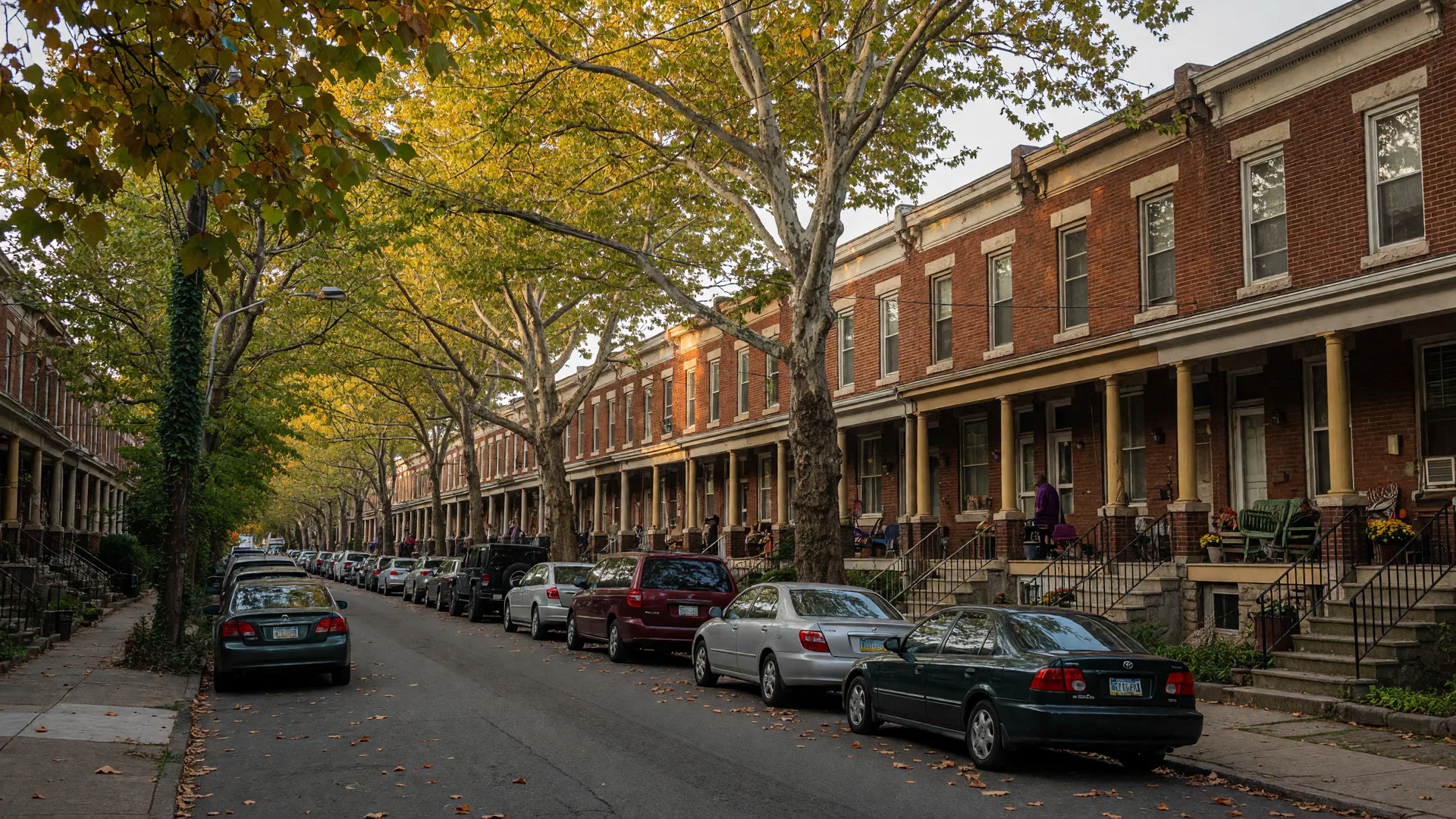
Living in East Mount
Airy
East Mount Airy is the eastern portion of one of Philadelphia's most beloved Northwest neighborhoods, a tree-lined, historic world of brick rowhomes and twins that tends to be more affordable than the stone Victorians across Germantown Avenue. Easier to reach via East Mount Airy Avenue and Stenton Avenue, bordered by Germantown to the east, it pairs genuine community character with the Chestnut Hill East Regional Rail ride into Center City and the Wissahickon Valley Park on its doorstep.
Mount Airy's more
affordable eastern half
Mount Airy has always had two faces, and Germantown Avenue is the seam between them. West Mount Airy is the storybook half, all gray stone Victorians and the Weavers Way Co-op, with the price tags that come with it. East Mount Airy is the eastern portion of the neighborhood, easier to reach via East Mount Airy Avenue and Stenton Avenue and bordered by Germantown to the east, and it delivers the same history, the same schools, and the same green community with a more welcoming price point built on brick rowhomes, twins, and multi-unit buildings.
Day to day, East Mount Airy is exactly what buyers picture when they think of classic Northwest Philadelphia: settled blocks of 20th-century brick houses, a live commercial corridor along Germantown Avenue, and the Wissahickon Valley Park literally on the doorstep. The Chestnut Hill East Regional Rail Line crosses the neighborhood and reaches Center City in about half an hour, so the city is close without living in its noise.
That combination, character plus value plus transit plus parkland, makes East Mount Airy attractive to a wide range of buyers, from first-time homebuyers and growing families to investors and downsizers. It also means homes here attract steady interest and hold their value, which matters whether you are buying your way in or thinking about selling and moving on.
A Chestnut Hill East rail ride
to Center City
The Chestnut Hill East Regional Rail Line is East Mount Airy's transit backbone. The line crosses right through the neighborhood, and the four stations East Mount Airy residents reach for most are Mount Airy at 119 East Gowen Avenue, plus Sedgwick, Stenton, and Washington Lane. Trains from these stations reach Center City in roughly 30 to 35 minutes, which is the commute that keeps the neighborhood so livable for people who work downtown.
SEPTA buses round out the picture. Route 18 runs through East Mount Airy between Fox Chase and Cedarbrook Plaza, Route 23 works the length of Germantown Avenue and ties into the wider Northwest, and Routes 53, 71, 51, and 81 connect to surrounding hubs and stations. Whether you ride the rail in for work or catch a bus along Germantown Avenue, Center City and the rest of the city are a short, reliable trip from East Mount Airy.
Germantown Avenue energy and
the Wissahickon on your doorstep
East Mount Airy's commercial life runs along Germantown Avenue, a corridor of shops, restaurants, bakeries, coffee shops, and services shared with West Mount Airy and Germantown, with the East Mount Airy Avenue and Stenton Avenue side serving as the neighborhood's easier access route. The avenue is also changing, with the former Trolley Car Diner site at 7619 Germantown Avenue now rising as a five-story, 114-unit mixed-use building and a proposed 81-unit workforce housing project eyed near Gorgas Lane, alongside the Sedgwick Theater's planned new illuminated marquee. Around it, green space and history expand the pace: the Wissahickon Valley Park, Forbidden Drive, and the creek lie right at the neighborhood's northwestern edge, while the historic landmarks of Germantown, Cliveden's Chew House, and the Johnson House sit just to the east. It is a mix of city energy and deep green calm that is hard to find in a single ZIP code.
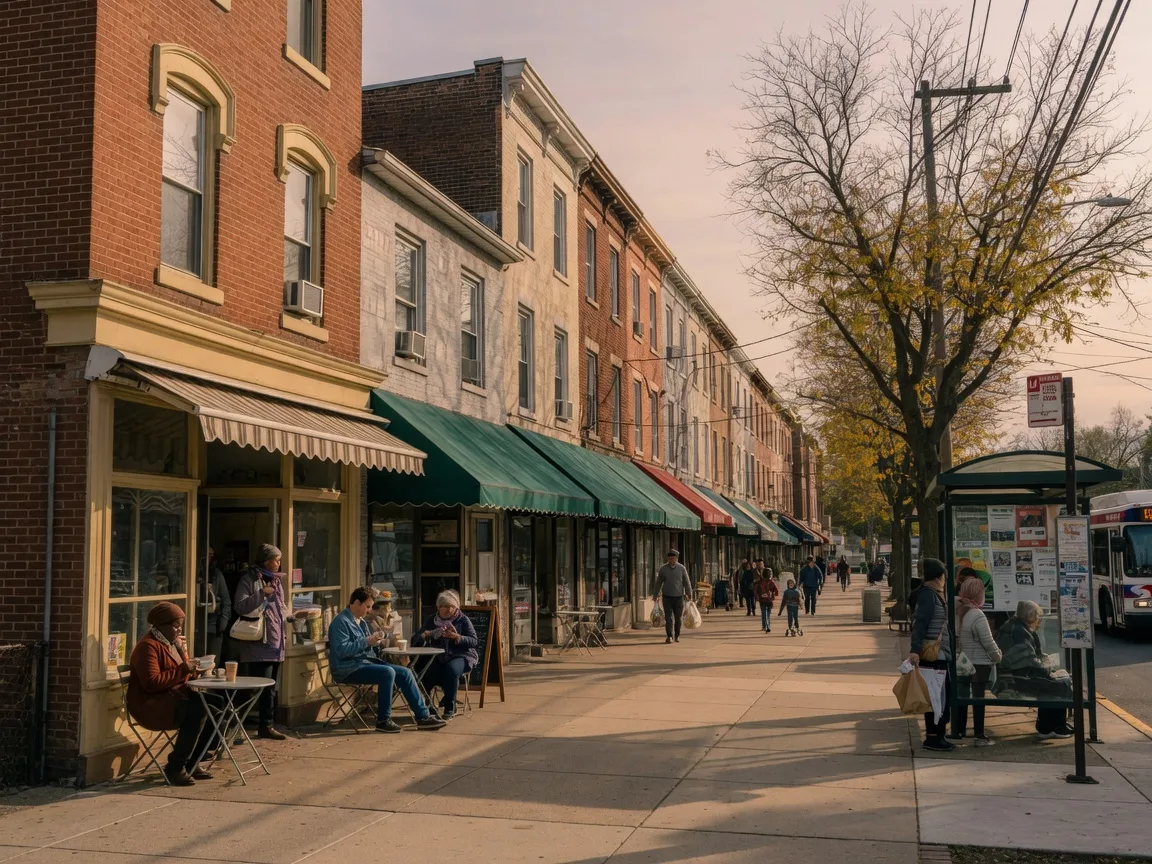
East Mount Airy's main street, lined with shops, bakeries, coffee spots, and restaurants where neighbors gather daily.
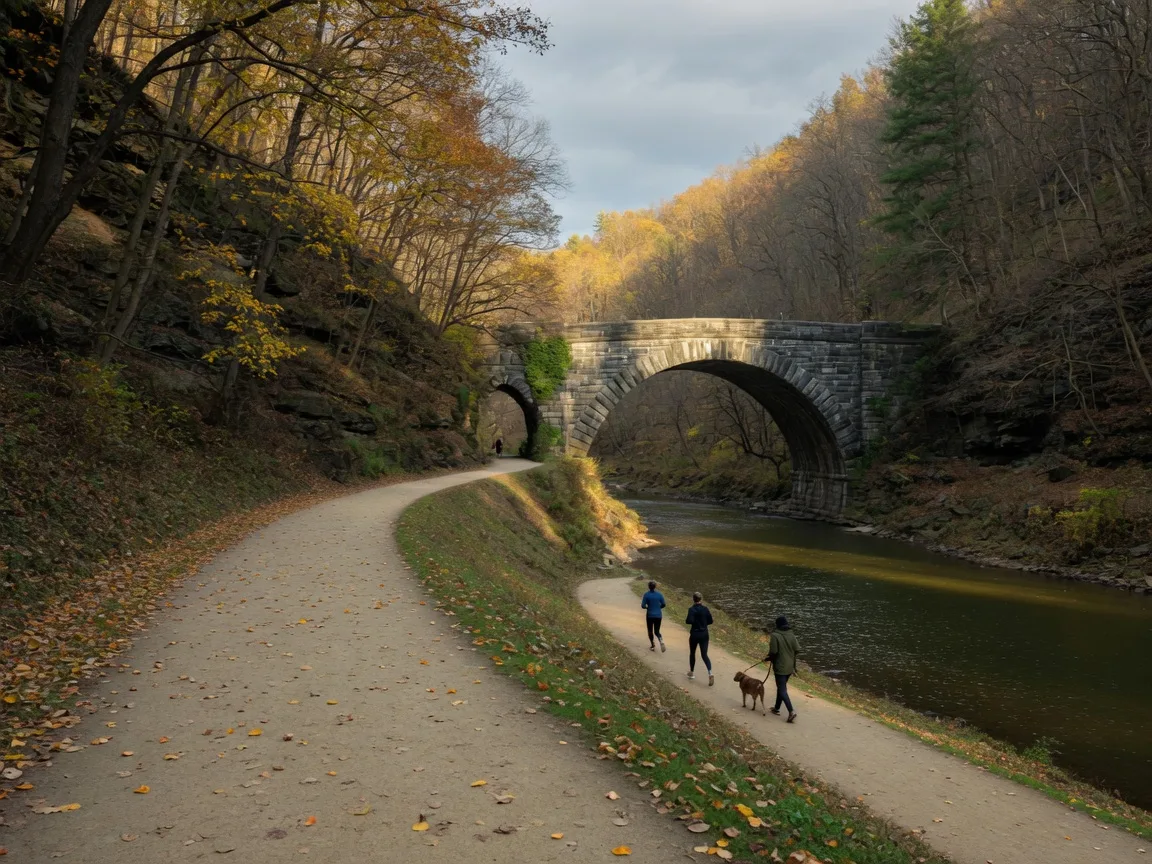
Miles of trails, Forbidden Drive, and the creek define the neighborhood's green edge, a private backyard of 1,800 acres.
Brick rowhomes, twins,
and multi-unit buildings
Walk almost any side street in East Mount Airy and you will see early- and mid-20th-century brick construction: rowhouses and twins, or semi-detached homes, set close to the sidewalk on a regular grid with some gently curving streets, along with scattered single-family homes and multi-unit buildings that make the area practical for income-producing buyers. Compared to the gray Wissahickon schist Victorians of West Mount Airy, this is a more modest, more uniform, and more affordable stock, and many homes have been thoughtfully updated by their owners over the years.
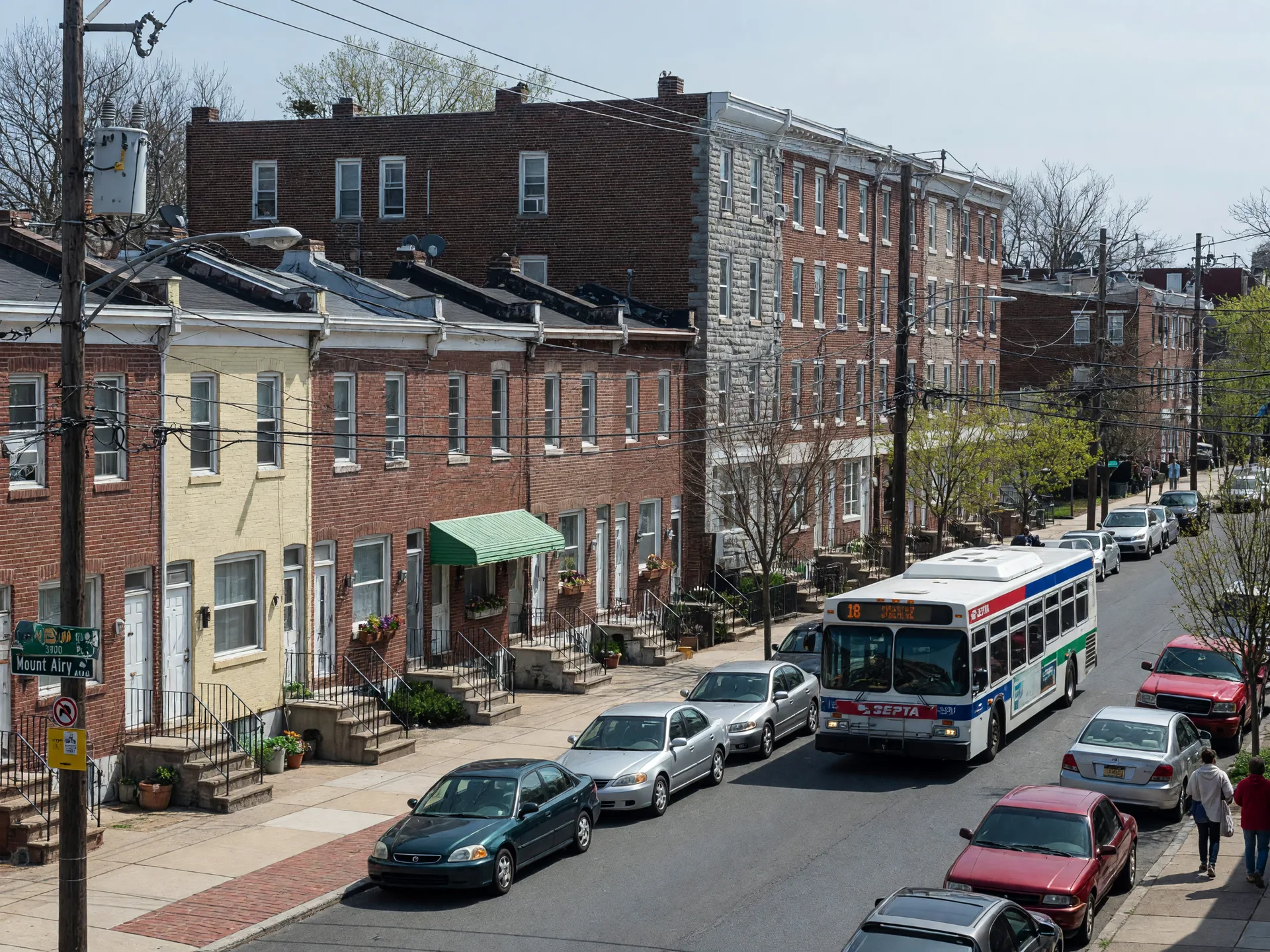
Prices reflect that affordability. East Mount Airy median home values sit in the low $300,000s, with many listings in the high $300,000s and average sale prices climbing into the $400,000s, while the broader 19119 ZIP reports medians around $326,000 to $371,000. The entry end, brick rowhouses and twins, is where first-time buyers and investors find real value, while updated and larger homes command more. It is a stable, owner-occupied market that does not churn, which holds value well but means serious buyers benefit from acting when the right home comes up.
Solid schools and a
civic-minded community
Schools
The main neighborhood K-8 catchment is Henry H. Houston School at 7300 Rural Lane, and the Mount Airy area feeds into The Academies at Roxborough, also known as Roxborough High School, with Charles W. Henry and Eleanor C. Emlen schools serving the western side of Mount Airy. Because boundaries are street-specific, the School District of Philadelphia School Finder is the authoritative way to confirm a home's assignment, and many East Mount Airy families also choose nearby parochial, charter, and selective-admission options.
Community Feel
Mount Airy is a nationally recognized model of neighbors choosing to build one community together, a legacy that took shape after World War II, and East Mount Airy carries that legacy forward. The community is organized through the East Mount Airy Neighbors civic association, founded in 1966, along with active block groups and events along the Germantown Avenue corridor, mixing longtime residents, young families, and retirees in a calm, family-oriented environment that is genuinely neighborly.
Common questions about
living in East Mount Airy & 19119
The questions homebuyers and sellers most often ask about the East Mount Airy section of the 19119 area, answered in full.
01 Is East Mount Airy a good place to live?
For most buyers, yes, and it comes down to balance. East Mount Airy is a settled, residential corner of Northwest Philadelphia where tree-lined blocks of historic brick rowhomes and twins sit within easy reach of both the Germantown Avenue commercial corridor and the 1,800-acre Wissahickon Valley Park. It tends to be more affordable than its neighbor across Germantown Avenue, which makes it especially attractive to first-time buyers, growing families, and investors. The community is famously neighborly, organized through block groups and the East Mount Airy Neighbors civic association, and generally quiet in feel compared to the busier parts of the city, though as with any large-city neighborhood conditions can vary from block to block, so it is always wise to walk a specific street at different times and check current block-level information before buying. For a homebuyer who wants city character, real history, and a green landscape without the higher price tag of West Mount Airy, East Mount Airy delivers.
02 What is the difference between East Mount Airy and West Mount Airy?
Germantown Avenue splits Mount Airy into two distinct halves, and the difference matters if you are house hunting. West Mount Airy is the more famous, more affluent half: grand gray Wissahickon stone Victorians and Colonial Revival homes, steep prices, and the Weavers Way Co-op that anchors daily life along Carpenter Lane and the western edge. East Mount Airy, as the name suggests, is the eastern portion of the neighborhood, easier to reach via East Mount Airy Avenue and Stenton Avenue and bordered by Germantown to the east. Its housing skews more modest and more affordable, centered on brick rowhomes, twins, and some multi-unit buildings that appeal strongly to first-time buyers and investors. The two halves share the same commercial corridor, the same historic context, and the same schools and rail access, but their price points and housing styles are noticeably different, which is exactly why buyers should be specific about which Mount Airy they mean.
03 How much do homes cost in East Mount Airy and the 19119 area?
East Mount Airy is one of the more affordable parts of the Mount Airy and 19119 market, and that is a big reason buyers gravitate to it. Neighborhood-level data puts East Mount Airy median home values in the low $300,000s, with many listings in the high $300,000s and average sale prices climbing into the $400,000s, while the broader 19119 ZIP code reports median home values around $326,000 to $371,000 depending on the source. The range reflects the mix of housing: more accessible brick rowhouses and twins enter on the lower end, while larger stone-front homes, updated twins, and multi-unit buildings command more. Because the market can shift and no two homes are alike, the useful takeaway is that East Mount Airy offers genuine Northwest Philadelphia character at a lower buy-in than the stone Victorians just across Germantown Avenue, which keeps both buyer interest and resale demand steady.
04 What are the homes like in East Mount Airy?
Housing in East Mount Airy is defined by early- and mid-20th-century brick construction. The streetscape is full of brick rowhouses and brick twins, or semi-detached homes, set close to the sidewalk on a regular grid with some gently curving streets, along with scattered single-family homes and a number of multi-unit buildings that make the area practical for income-producing buyers. Many homes keep classic details, front steps, porches, and deep windows, and owners have updated interiors over the years. Compared to the gray Wissahickon schist Victorians of West Mount Airy, the brick stock here is more modest, more uniform, and more affordable, which is precisely what draws first-time buyers looking to get a foothold in a historically rich part of the city. On most blocks you will also find a healthy share of longtime homeowners, giving the neighborhood a stable, owned-not-churned feel.
05 What schools serve East Mount Airy in the 19119 area?
East Mount Airy is served by the School District of Philadelphia on an address-based catchment system. The main neighborhood K-8 catchment school is Henry H. Houston School at 7300 Rural Lane, and the feeder high school for the Mount Airy area is The Academies at Roxborough, also known as Roxborough High School, with Charles W. Henry and Eleanor C. Emlen schools serving the western side of Mount Airy across Germantown Avenue. Because exact boundaries are street-specific and can fall differently block by block, the official School District of Philadelphia School Finder is the authoritative way to confirm which school a particular home maps to. Many East Mount Airy families also weigh nearby parochial, charter, and selective-admission options, which is why we always sit down with buyers to talk through the school picture for a specific address before they commit.
06 How do you get to Center City from East Mount Airy?
The Chestnut Hill East Regional Rail Line is the fastest way downtown, and East Mount Airy is its home turf. The line crosses the neighborhood with the Mount Airy station at 119 East Gowen Avenue, plus Sedgwick, Stenton, and Washington Lane stations, the four stations that East Mount Airy residents rely on most. Trains from the Mount Airy-area stations reach Center City in roughly 30 to 35 minutes, which is the commute most residents quote when they talk about why the location is so livable. SEPTA buses add flexibility: Route 18 runs through East Mount Airy between Fox Chase and Cedarbrook Plaza, the Route 23 bus works the length of Germantown Avenue and connects to the wider Northwest, and Routes 53, 71, 51, and 81 link to surrounding hubs. Whether you are riding the rail in for work or catching a bus to midtown, Center City is a short, reliable trip from East Mount Airy.
07 Is East Mount Airy walkable, and do you need a car?
East Mount Airy is one of the more walkable residential sections of Northwest Philadelphia. Most blocks are compact, tree-lined, and easy to walk, and the Germantown Avenue corridor threading the neighborhood puts shops, restaurants, bakeries, coffee shops, and services within a comfortable stroll from many homes, much of it reinforced by the area's wide sidewalks and transit stops. The SEPTA buses and the Chestnut Hill East Regional Rail stations mean you can live in East Mount Airy without depending on a car for the daily commute, and many households do exactly that. Where a car genuinely helps is big shopping trips, weekend trips into the Wissahickon, and running errands to the suburbs, so most families keep at least one vehicle. The realistic answer: walk and transit cover your everyday life, and a car widens your range for the bigger trips.
08 How close is East Mount Airy to Germantown?
East Mount Airy sits directly beside Germantown, with the two neighborhoods sharing the Germantown Avenue corridor and East Mount Airy being bordered by Germantown to the east along the Stenton Avenue side. In practice the streets blend into one another, so residents cross the invisible neighborhood line constantly for the shops, bakeries, restaurants, and institutions that line Germantown Avenue. That junction is also steeped in history: the Battle of Germantown was fought just to the southeast, centered on Cliveden, the famous 1760s Chew House that is now a National Historic Landmark, with the Johnson House Underground Railroad site nearby as well. Living in East Mount Airy means having Germantown's historic landmarks, its commercial life, and its transit connections essentially at your doorstep, with the more distinct Mount Airy community as your home base.
09 Is East Mount Airy close to the Wissahickon?
Yes, and for many residents it is the neighborhood's best feature. East Mount Airy backs right up to the Wissahickon Valley Park, the beautiful 1,800-acre woodland held by the Fairmount Park Commission since 1868 that runs along the northwestern edge of the neighborhood. Forbidden Drive, the famous flat crushed-stone trail beside the Wissahickon Creek, is minutes from East Mount Airy homes, giving residents miles of trails for jogging, dog walking, biking, and riding, plus the creek itself for fishing and quiet reflection. Access points and overlooks near the neighborhood lead into the park's old-growth woods and its historic structures, including the Monastery House and Stables perched above the valley. It is rare to live in a city neighborhood with a genuine forest reserve on your doorstep, and East Mount Airy's location makes the Wissahickon feel like a private backyard.
10 What is the community feel in East Mount Airy?
Mount Airy is a nationally recognized model of neighbors choosing to build one community together, a legacy that took shape after World War II, and East Mount Airy carries that legacy forward in its everyday feel. The community is organized, neighborly, and civic-minded, anchored by the East Mount Airy Neighbors civic association, founded in 1966 with the motto "Making a Good Community Better," plus active block groups, gardens, and events along the Germantown Avenue corridor. Blocks mix longtime residents, young families, and retirees, and the pace is calm and family-oriented rather than nightlife-driven. Combined with the historic housing, the schools, the transit access, and the Wissahickon on the doorstep, it makes East Mount Airy a place where people tend to buy and stay, which is exactly the kind of settled, desirable character that sustains strong buyer demand and healthy resale values.
11 What new developments are planned in East Mount Airy?
A good deal of new investment is working its way through East Mount Airy. The former Trolley Car Diner site at 7619 Germantown Avenue is being redeveloped by Main Street Development into a five-story, 114-unit mixed-use apartment building with ground-floor commercial space, with vertical construction underway. Local developer TierView has also proposed an 81-unit apartment building targeting middle-income renters, just off Gorgas Lane near the Lovett Memorial Library, though it still needs zoning approval before construction. On the cultural side, the Sedgwick Theater is planning a new illuminated marquee as part of a major renovation of the historic building that is home to the Quintessence Theatre Group. The community calendar stays busy too, with Mt. Airy Restaurant Week returning in March and the Go Mt. Airy Supper Sessions closing blocks of Germantown Avenue to traffic for outdoor dining through the summer.
Wondering what YOUR home in East Mount Airy is worth? Get a free, no-pressure valuation.
Buying or selling in
East Mount Airy?
Whether you want to buy your first brick rowhome in East Mount Airy, find an income-producing twin, or sell in the 19119 area and get the best price, I will listen to your situation and put together a clear plan. Let's talk.