
Living in West Mount
Airy
West Mount Airy is the affluent western half of one of Philadelphia's most beloved Northwest neighborhoods, the portion west of Germantown Avenue that borders Chestnut Hill and the Wissahickon Valley. It is the more well-to-do side of Mount Airy, a world of historic gray Wissahickon schist Victorian twins and stone homes on deeply tree-lined streets, celebrated for its pioneering spirit of neighbors building one community together and anchored by the Weavers Way Co-op.
Mount Airy's more
affluent western half
Mount Airy has always had two faces, and Germantown Avenue is the seam between them. West Mount Airy is the storybook half, the strip west of Germantown Avenue that borders Chestnut Hill and the Wissahickon Valley. It is the more affluent side of the neighborhood, lined with grand gray Wissahickon schist Victorian twins, stone and brick homes, and deeply tree-lined streets, with price tags that reflect the architectural pedigree.
Day to day, West Mount Airy is exactly what buyers picture when they think of classic Northwest Philadelphia: historic houses, a beloved member-owned co-op in Weavers Way on Carpenter Lane, a nationally famous legacy of neighbors building one community together, and the Wissahickon Valley Park literally on the western doorstep. The Chestnut Hill West Regional Rail line reaches Center City in about half an hour, so the city is close without living in its noise.
That combination, historic character, genuine community, transit, and parkland, makes West Mount Airy one of the most desired ZIP codes in the city, attractive to longstanding families, downsizers, and buyers who want the very best of Philadelphia living. It also means homes here attract steady interest and hold their value exceptionally well, which matters whether you are buying your way in or thinking about selling and moving on.
A Chestnut Hill West rail ride
to Center City
The Chestnut Hill West Regional Rail line is West Mount Airy's transit backbone. The line runs from Center City out through Northwest Philadelphia, and Allen Lane station, renamed Richard Allen Lane in 2022, is the neighborhood's own stop, with Carpenter, Upsal, and Tulpehocken stations also serving West Mount Airy. Trains from Allen Lane reach Center City in roughly 30 to 35 minutes, which is the commute residents quote when they talk about why the location is so livable.
SEPTA's Stenton station on the Chestnut Hill East line is also close at hand, giving residents of the neighborhood's eastern side a second rail option just across Germantown Avenue. SEPTA buses round out the picture, with Route 23 working the length of Germantown Avenue into the wider Northwest and Route 53 connecting nearby streets and hubs. Whether you ride the rail in for work or catch a bus along Germantown Avenue, Center City and the rest of the city are a short, reliable trip from West Mount Airy.
Carpenter Lane life and
the Wissahickon on your doorstep
West Mount Airy's commercial life centers on Carpenter Lane, a beloved retail street anchored by the Weavers Way Co-op, along with bakeries, coffee shops, restaurants, and small businesses, with the western edge of Germantown Avenue adding even more daily options. The dining scene has welcomed fresh arrivals too, including Dohō, an upscale Latin-Asian bistro and cocktail spot that opened at 18 West Hortter Street in October 2025, and a new ReAnimator Coffee shop that opened at 6509 Germantown Avenue in July 2025. Around it, green space and history expand the pace: the Wissahickon Valley Park, Forbidden Drive, and the creek lie right at the neighborhood's western edge, reached from trailheads like Mt. Airy Avenue and Kitchens Lane, while historic Chestnut Hill and its boutiques and farmers' market sit just beyond. It is a mix of village energy and deep green calm that is hard to find in a single ZIP code.
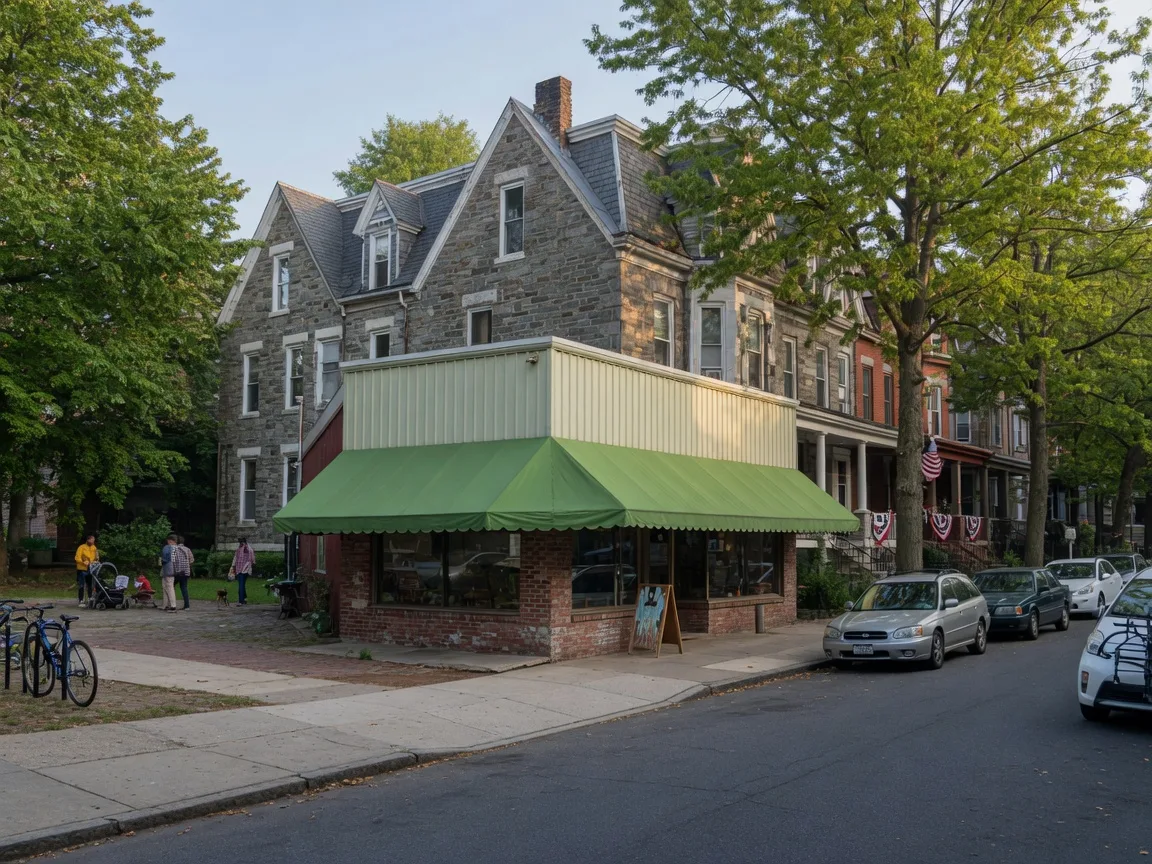
The neighborhood's village heart, built around the member-owned Weavers Way Co-op, cafes, bakeries, and historic stone homes.
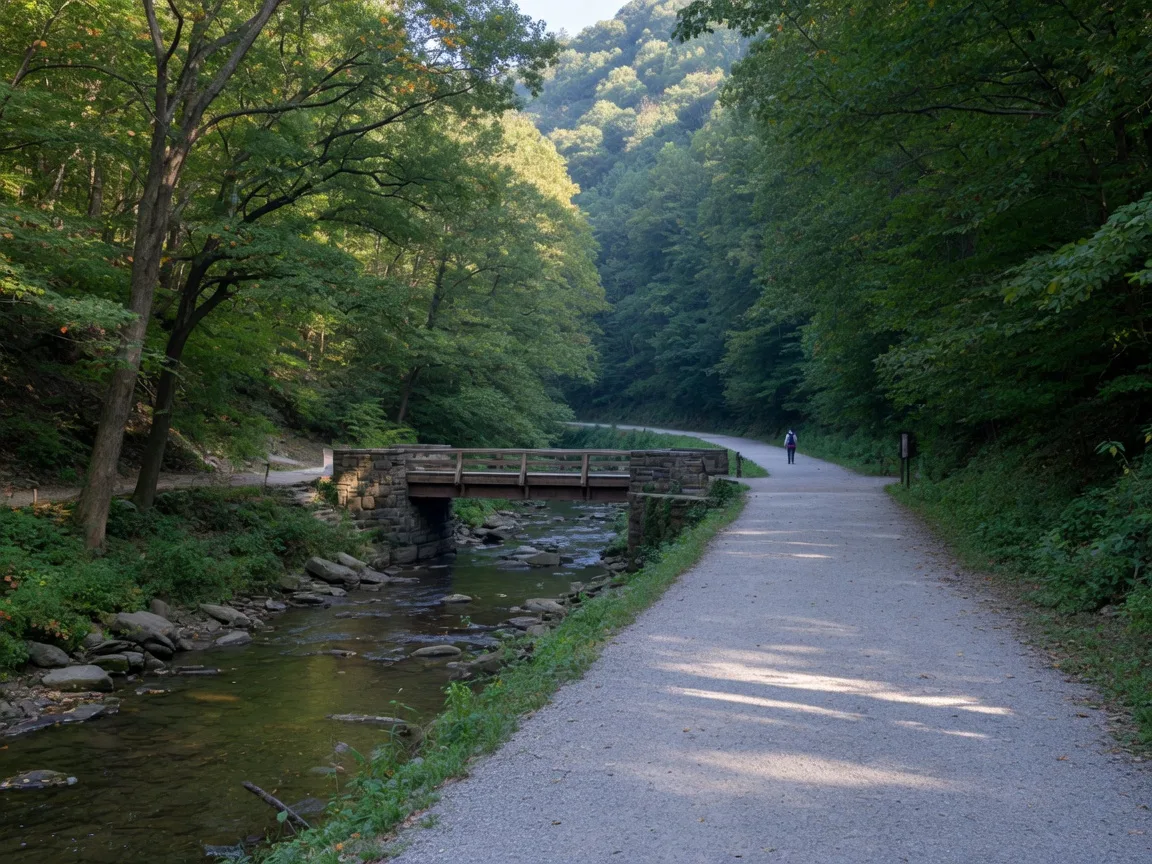
Miles of trails, Forbidden Drive, and the creek define the neighborhood's green edge, a private backyard of 1,800 acres.
Historic gray stone Victorians
and homes of real pedigree
Walk almost any side street in West Mount Airy and you will see late-19th- and early-20th-century construction: large three-story Victorian twins and single-family homes of locally quarried gray Wissahickon schist, set back on deep lawns behind mature trees, along with elegant Colonial Revival, Norman, and Cotswold-style houses. Many keep stained-glass windows, slate roofs, deep porches, bay windows, and tall chimneys, and the architectural variety is concentrated in historic districts such as Pelham, a Wendell and Smith development from the 1890s. Compared to the more modest brick stock of East Mount Airy just across Germantown Avenue, this is a grander, more architecturally significant, and more expensive collection of homes.
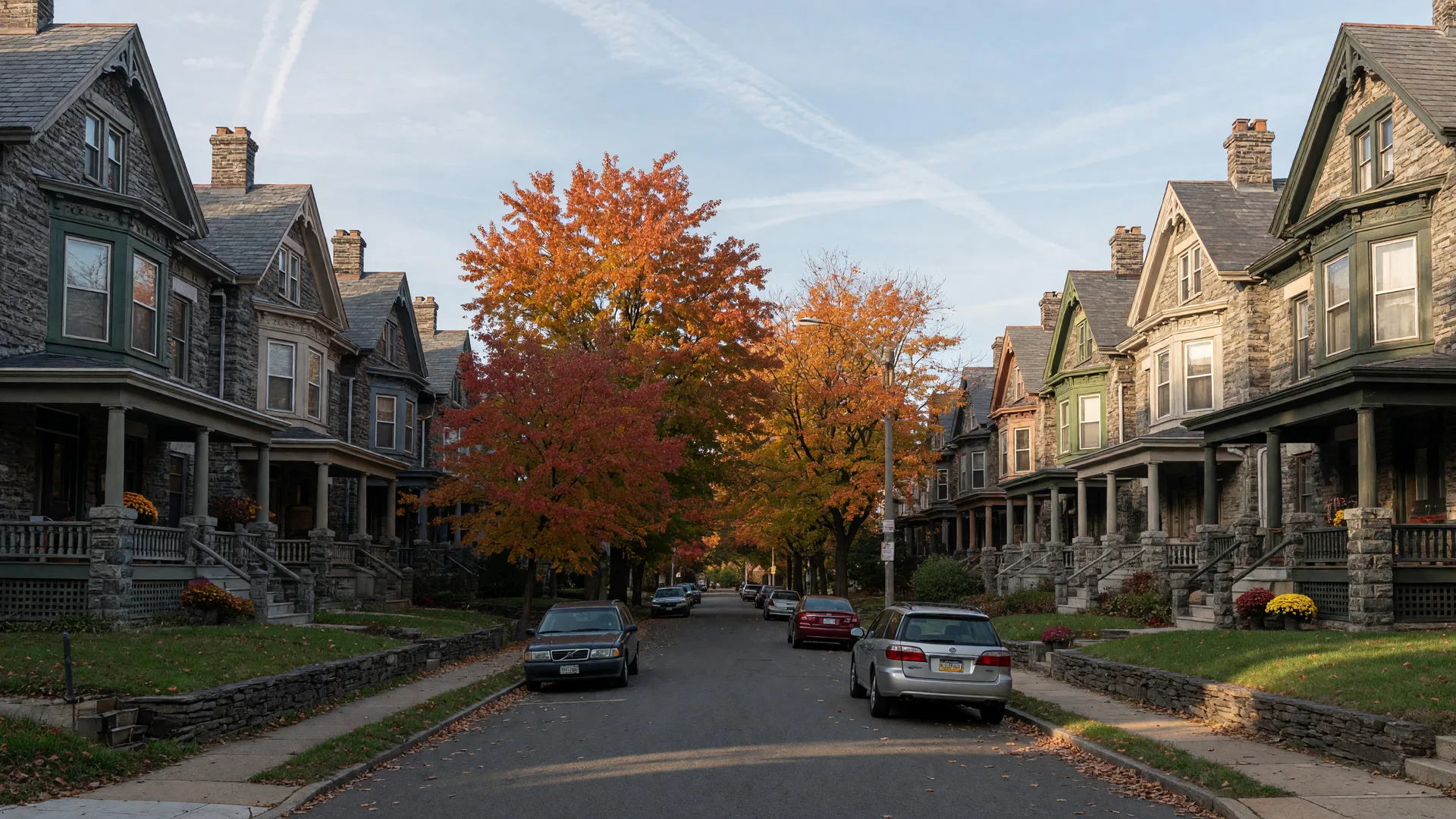
Prices reflect that pedigree. Current market data puts typical West Mount Airy home values around $446,000 on Zillow, with Redfin reporting a median sale price near $705,000 and Homes.com a median around $565,000, or roughly $727,500 for single-family homes. The entry end, smaller twins and brick homes, starts in the low to mid $400,000s, while fully restored stone Victorians and grand Pelham houses command well into the $700,000s and beyond. It is a stable, owner-occupied market that does not churn, which holds value exceptionally well but means serious buyers benefit from acting when the right home comes up.
Solid schools and a
pioneering, welcoming community
Schools
The main neighborhood K-8 catchment school is Charles W. Henry School at 601 Carpenter Lane, with Eleanor C. Emlen School at 6501 Chew Avenue serving early-elementary years and Henry H. Houston and Anna L. Lingelbach schools nearby. Feeder paths lead to The Academies at Roxborough and Martin Luther King High School. Because boundaries are street-specific, the School District of Philadelphia School Finder is the authoritative way to confirm a home's assignment, and many West Mount Airy families also choose nearby private, parochial, and selective-admission options.
Community Feel
West Mount Airy is a nationally recognized model of neighbors choosing to welcome one another and grow together, a legacy that began in the 1950s, carried forward by West Mount Airy Neighbors, founded in 1959, and anchored by institutions like the Weavers Way Co-op and the Mt. Airy CDC. Blocks mix longtime residents, young families, academics, artists, and retirees in a calm, family-oriented environment that is genuinely neighborly and deeply civic.
Common questions about
living in West Mount Airy & 19119
The questions homebuyers and sellers most often ask about the West Mount Airy section of the 19119 area, answered in full.
01 Is West Mount Airy a good place to live?
For most buyers, yes, and it is one of the most sought-after places to live in all of Philadelphia. West Mount Airy is the affluent western half of Mount Airy, the strip of Northwest Philadelphia west of Germantown Avenue that borders Chestnut Hill and the Wissahickon Valley Park. It is internationally respected as one of the first neighborhoods in the United States where long-time locals and newcomers chose, deliberately, to build one community together, a distinction that has held for more than 60 years and is woven into everyday life here. Residents get grand historic Victorian homes of gray Wissahickon schist, deeply tree-lined streets, excellent transit on the Chestnut Hill West Regional Rail line into Center City, a beloved member-owned co-op in Weavers Way, and a forest preserve, the Wissahickon Valley Park, on the doorstep. It is also one of the pricier ZIP codes in the city, so it attracts buyers who want substantial historic character, walkability, and a close-knit, civic-minded community and are willing to pay for it. For the right buyer, West Mount Airy is not just a good place to live, it is a place people move to and stay for decades.
02 What is the difference between West Mount Airy and East Mount Airy?
Germantown Avenue is the seam that divides Mount Airy into two distinct halves, and the difference is significant when you are choosing where to buy. West Mount Airy, the portion west of Germantown Avenue, is the more affluent and more famous half: grand three-story Victorian twins and mansions built of gray Wissahickon schist stone, slate roofs, stained glass, steep prices, and the Weavers Way Co-op anchoring daily life along Carpenter Lane. It borders Chestnut Hill to the northwest and the Wissahickon Valley Park along its western edge. East Mount Airy, as the name suggests, is the eastern portion, with more modest, more affordable brick rowhomes and twins that appeal strongly to first-time buyers and investors. The two halves share the same Germantown Avenue commercial corridor, many of the same schools, and the same historic context, but their housing stock, price points, and character are noticeably different, which is exactly why buyers should be specific about which Mount Airy they mean.
03 How much do homes cost in West Mount Airy and the 19119 area?
West Mount Airy sits at the premium end of the Northwest Philadelphia market, and prices reflect the historic stone housing stock. Current market data puts typical home values in the 19119 ZIP at roughly $446,000 on Zillow, with Redfin reporting a median sale price near $705,000 and Homes.com a median around $565,000, climbing to roughly $727,000 for single-family homes at about $254 to $257 per square foot. In practice, prices range widely with the housing: smaller brick and stone twins and townhouses enter in the low to mid $400,000s, while fully restored gray schist Victorians, large Colonial Revival homes, and the grand houses of the Pelham section command well into the $700,000s and beyond. Because the market moves and every historic home is unique, the useful takeaway is that West Mount Airy is one of the city's more valuable and stable markets, and buyers should expect to move quickly when the right house comes up.
04 What are the homes like in West Mount Airy?
Housing here is the neighborhood's defining feature and mostly dates to the late 19th and early 20th centuries. The streetscape is full of large three-story Victorian twins and single-family homes built of locally quarried gray Wissahickon schist, along with elegant Colonial Revival, Norman, and Cotswold-style houses. Many retain stained-glass windows, slate roofs, deep porches, bay windows, and tall chimneys that give the blocks their storybook character. The architectural diversity is concentrated in historic districts such as Pelham, a Wendell and Smith development from the 1890s where homes range from Jacobean and Colonial styles to Norman Revival and Victorian-era designs. Owners over the years have updated interiors, kitchens, and systems while protecting the period facades, which is exactly why these homes hold value so well. If you want Philadelphia character with genuine architectural pedigree, West Mount Airy delivers it in abundance.
05 What schools serve West Mount Airy in the 19119 area?
West Mount Airy is served by the School District of Philadelphia on an address-based catchment system. The main neighborhood K-8 school is Charles W. Henry School at 601 Carpenter Lane, and for early elementary years Eleanor C. Emlen School at 6501 Chew Avenue covers part of the area, with Henry H. Houston School at 7300 Rural Lane and Anna L. Lingelbach School serving nearby parts of 19119. High school assignment is choice-based, but the neighborhood feeder paths lead to The Academies at Roxborough, also known as Roxborough High School, and Martin Luther King High School, which Emlen and Roosevelt students follow. Because boundaries are street-specific and can fall differently block by block, the official School District of Philadelphia School Finder is the authoritative way to confirm which school a particular home maps to. Many West Mount Airy families also weigh nearby private, parochial, and selective-admission options, and this neighborhood is known for strong community investment in its public schools, which is something we always walk buyers through address by address.
06 How do you get to Center City from West Mount Airy?
The Chestnut Hill West Regional Rail line is West Mount Airy's transit backbone. The line runs from Center City out through Northwest Philadelphia, and Allen Lane station, renamed Richard Allen Lane in 2022, is the neighborhood's own stop on the line, with Carpenter, Upsal, and Tulpehocken stations also serving West Mount Airy. Trains from Allen Lane reach Suburban Station in roughly 30 to 35 minutes and Jefferson Station in about 35, which is the commute residents quote when they talk about why the location works for downtown jobs. SEPTA's Stenton station on the Chestnut Hill East line is also close at hand, giving residents of the neighborhood's eastern side a second rail option just across Germantown Avenue. SEPTA buses add flexibility, with the Route 23 bus working the length of Germantown Avenue and Route 53 connecting nearby streets, so whether you ride the rail in for work or catch a bus, Center City is a short, reliable trip from West Mount Airy.
07 Is West Mount Airy walkable, and do you need a car?
West Mount Airy is one of the more walkable residential sections of Philadelphia. The historic blocks are compact, tree-lined, and pleasant on foot, and the commercial life around Carpenter Lane and along the western edge of Germantown Avenue puts the Weavers Way Co-op, bakeries, coffee shops, restaurants, and services within a short stroll of many homes. The Chestnut Hill West Regional Rail line and local SEPTA buses mean you can live here without depending on a car for the daily commute, and many households do exactly that. Where a car genuinely helps is weekend trips into the Wissahickon for hiking and mountain biking, big shopping runs, and errands into Chestnut Hill or the suburbs, so most families keep at least one vehicle. The realistic answer: walk and transit cover your everyday life in West Mount Airy, and a car widens your range for trips into the park and beyond.
08 How close is West Mount Airy to Chestnut Hill?
West Mount Airy sits directly beside Chestnut Hill, sharing its western border with that famously picturesque neighborhood, and the two merge into one another along the quiet streets just the other side of the Wissahickon Valley. Residents cross the invisible line constantly for Chestnut Hill's boutiques, restaurants, cafes, the Chestnut Hill Farmers' Market, and the shops along Germantown Avenue and Bethlehem Pike, while coming home to West Mount Airy's slightly more laid-back character and lower per-square-foot prices. The proximity works both ways: the Chestnut Hill West Regional Rail line threads through both neighborhoods, so riders from Allen Lane have direct access to the same line that serves Chestnut Hill's western edge. Between the shared rail access, the instant access to the Wissahickon, and daily life rolling back and forth, living in West Mount Airy effectively gives you Chestnut Hill's amenities as an extension of your own neighborhood.
09 Is West Mount Airy close to the Wissahickon?
Yes, and for many residents it is the neighborhood's best feature. West Mount Airy backs directly onto the Wissahickon Valley Park, the beautiful 1,800-acre woodland held by the Fairmount Park Commission since 1868 that runs along the neighborhood's western edge. Forbidden Drive, the famous flat crushed-stone multi-use trail beside the Wissahickon Creek, is minutes from West Mount Airy homes, reached from trailheads like the Mt. Airy Avenue trailhead just downhill from Wissahickon Avenue, plus Kitchens Lane and the Bells Mill Road access. Those access points give residents miles of trails for hiking, jogging, dog walking, road and mountain biking, and riding, plus the creek itself for fishing and quiet reflection and the historic Monastery Stables above the valley. It is rare to live in a city neighborhood with a genuine forest reserve on your doorstep, and West Mount Airy's location makes the Wissahickon feel like a private backyard.
10 What is the community feel in West Mount Airy?
West Mount Airy is best known for its community, and with good reason: it is a nationally recognized model of neighbors choosing to welcome one another and grow together, a legacy that began in the early 1950s. When new families began buying homes here after World War II, church and lay leaders organized around a moral statement, "This We Believe About Our Neighborhood," and neighbors chose to welcome rather than resist change, forming West Mount Airy Neighbors in 1959 to keep the community strong and united. That legacy still defines daily life here, mixing longtime residents, young families, academics, artists, and retirees in a calm, family-oriented, deeply civic environment. The community coheres around institutions like Weavers Way Co-op, founded in 1973 and now one of the region's largest member-owned cooperatives, along with active block groups, gardens, the Mt. Airy CDC, and historic house fairs that celebrate the neighborhood's architecture. People here tend to buy and stay for decades, which is exactly the settled, desired character that sustains strong buyer demand and healthy resale values.
11 What new restaurants and cultural venues are in West Mount Airy?
West Mount Airy has seen a welcome round of new dining and cultural energy. Doho, an upscale Latin-Asian bistro and cocktail spot, opened in October 2025 at 18 West Hortter Street, just off Germantown Avenue, filling the fine-dining gap in the neighborhood. Philadelphia roaster ReAnimator Coffee opened a new Mount Airy shop at 6509 Germantown Avenue on July 3, 2025, joining the local coffee scene. On the cultural side, the Lantern Theater Company is working toward a Northwest Philadelphia expansion into the former Mount Airy Presbyterian Church with a planned 2027 opening, and the Quintessence Theatre Group has moved ahead with plans for a new illuminated marquee at the Sedgwick Theater. The community calendar stays busy with Mount Airy Restaurant Week each March and the Go Mount Airy Supper Sessions, which close blocks of Germantown Avenue to traffic for outdoor dining through the summer.
Wondering what YOUR home in West Mount Airy is worth? Get a free, no-pressure valuation.
Buying or selling in
West Mount Airy?
Whether you want to buy a historic stone Victorian in West Mount Airy, find the right family home in the 19119 area, or sell a property here and get the best price, I will listen to your situation and put together a clear plan. Let's talk.